
Key Takeaways

  • The Statement of Information keeps California’s records current and must include accurate details about management, address, and business activity. Missing or incorrect information can cause compliance issues.
  • Filing timelines vary by entity type. LLCs and nonprofits file every two years, while corporations must file annually after the initial submission.
  • Late or missing filings can lead to penalties, suspension, and loss of good standing, which can disrupt normal business operations.

Maintaining compliance with California business regulations requires timely submission of a Statement of Information. This filing keeps the state updated on essential company details such as ownership, management, and contact information. Missing deadlines or submitting incomplete information can lead to penalties, suspension, or loss of good standing.

Ahead, we’ll explain how to file a Statement of Information in California, including what must be included, when to file, and how California’s rules apply to different business structures.

File Your California Statement of Information!

Need help filing your California statement of information?
California Statement of Information Filing Requirements

What Is a Statement of Information?

A Statement of Information (SOI) is a required filing submitted to the California Secretary of State. You may also hear it referred to as a California annual report. It provides updated records about a business entity’s structure and operations. The state uses this information to ensure transparency and maintain accurate public records.

Businesses that must file include:

  • Limited liability companies (LLCs)
  • Corporations (both domestic and foreign)
  • Nonprofit organizations

Each entity type has slightly different SOI filing rules, though the purpose remains consistent across all categories.

Required Information in the CA Statement of Information Filing

The Statement of Information must include accurate and current details about the business. Providing outdated or incorrect information can lead to compliance issues.

1. Business Identification Details

Every filing must clearly identify the entity. Required elements include:

  • Legal business name as registered with the state
  • California Secretary of State file number
  • Business address, including street and mailing address

The business address must be a physical location. P.O. boxes alone are not accepted for the primary address.

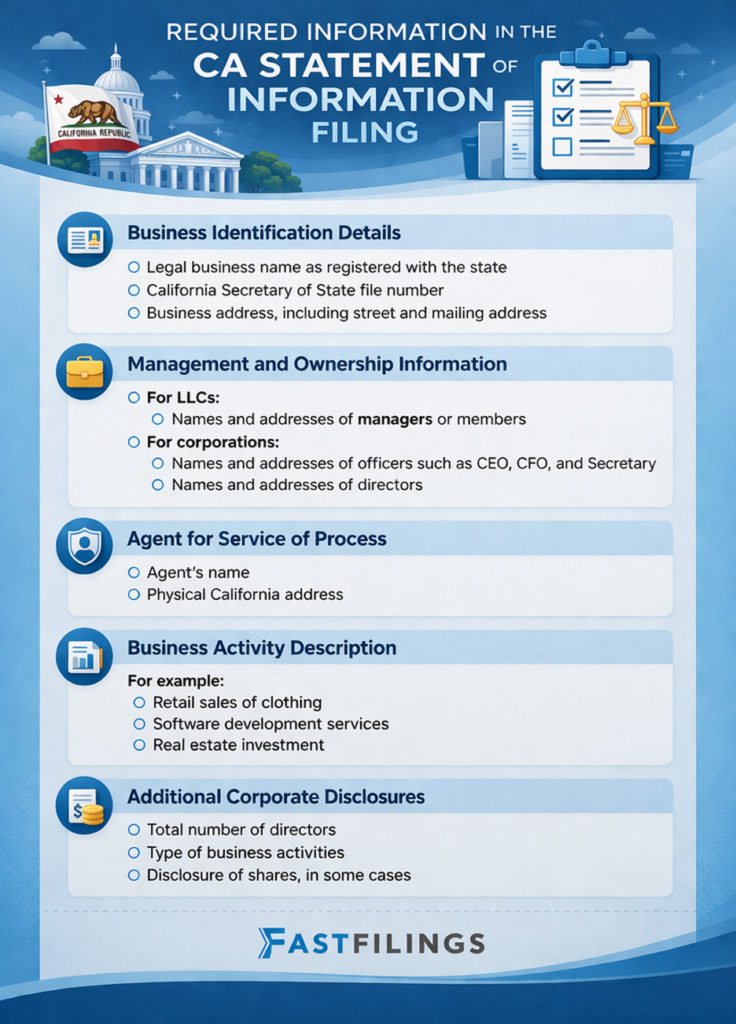
2. Management and Ownership Information

The filing must disclose individuals responsible for managing the business.

For LLCs:

  • Names and addresses of managers or members

For corporations:

  • Names and addresses of officers such as CEO, CFO, and Secretary
  • Names and addresses of directors

This section ensures accountability and allows the state to track who is responsible for business decisions.

3. Agent for Service of Process

Every business must designate an agent for service of process (or registered agent). This individual or company receives legal documents on behalf of the business.

Requirements include:

  • Agent’s name
  • Physical California address

The agent must be available during normal business hours. Businesses may choose an individual or a registered corporate agent.

4. Business Activity Description

California requires a brief description of the business’s primary activity. This does not need to be lengthy but must accurately reflect what the company does.

Examples include:

  • Retail sales of clothing
  • Software development services
  • Real estate investment

5. Additional Corporate Disclosures

Corporations may need to provide extra details, such as:

  • Total number of directors
  • Type of business activities
  • Disclosure of shares, in some cases

These requirements vary depending on the corporation’s classification.

Gather your business documentation and information
Statement of Information Filing Requirements in California
Step 2 - Complete the online application form

Filing Deadlines and Frequency

Filing timelines depend on the type of business entity. Missing deadlines can result in penalties and possible suspension.

LLC Filing Timeline

  • Initial filing: Within 90 days of registration
  • Ongoing filings: Every two years

The biennial filing is due during the same calendar month as the original registration date.

Corporation Filing Timeline

  • Initial filing: Within 90 days of incorporation
  • Ongoing filings: Annually

Corporations must file every year, which makes their compliance schedule more frequent than LLCs.

Nonprofit Filing Timeline

  • Initial filing: Within 90 days
  • Ongoing filings: Every two years

Nonprofits follow a similar schedule to LLCs unless additional reporting is required under federal or state regulations.

Filing Methods

California allows multiple ways to submit the Statement of Information.

Online Filing

The most efficient option is filing online through either the Secretary of State’s online portal or a third-party online filing service. Benefits include:

  • Faster processing
  • Immediate confirmation
  • Reduced risk of clerical errors

Mail Filing

Businesses may also submit CA Statement of Information forms by mail. This option takes longer and requires careful review to avoid rejection.

Seller’s Permit and Resale Certificate

Filing Fees

Fees vary depending on the entity type.

  • LLC: $20
  • Corporation: $25
  • Nonprofit: $20

Additional fees may apply for late filings, expedited processing, or utilizing a third-party online filing service.

Consequences of Noncompliance

Failure to file a Statement of Information can create serious problems for a business.

Financial Penalties

Late filings may result in fines. These penalties increase over time if the issue is not resolved.

Suspension or Forfeiture

The state may suspend or forfeit a business that fails to comply. This status prevents the company from:

  • Conducting business legally
  • Entering contracts
  • Defending itself in court

Loss of Good Standing

A business that is not in good standing may face difficulty securing financing, entering partnerships, or renewing licenses.

What Documents Do I Need?
File Your Statement of Information Online in California

Updating Information Between Filings

Businesses are not required to wait for their scheduled filing to report changes. If key information changes, an updated Statement of Information can be filed at any time.

Common reasons for updates include:

  • Change of business address
  • New officers or managers
  • Updated agent for service of process

Filing updates promptly helps avoid discrepancies in state records.

File Your Statement of Information Online in California

Keeping up with California filing requirements protects your business from penalties and suspension. FastFilings helps ensure your CA Statement of Information forms are completed accurately and submitted on time.

With FastFilings, you get a straightforward online process built for compliance and speed. Get started with FastFilings today and file your Statement of Information without delays.

FAQs

What is the initial Statement of Information in California?

The California initial Statement of Information is the first required filing submitted to the Secretary of State after a business is formed in California. It must be filed within 90 days of formation.

How often does the Statement of Information for an LLC in California need to be filed?

The Statement of Information for an LLC in California must be filed every two years after the initial filing. 

How often does the California corporation Statement of Information need to be filed?

The California corporation Statement of Information must be filed every year after the initial filing. 

What happens if I miss the filing deadline?

The state may impose late fees and eventually suspend the business. Suspension limits the company’s ability to operate legally.

Do I need to file if nothing has changed?

Yes. You are still required to submit a Statement of Information even if all information remains the same.

Is the filing public?

Yes. Information submitted becomes part of the public record and can be accessed through the Secretary of State.

File Your California Statement of Information!

Need help filing your statement of information in California?